How to Read a Peptide COA
The complete guide to knowing what is actually in your vial.
11 sections
- Top of article
- The two machines behind every real COA
- The number almost everyone misses: net content
- Reading a results table
- A real one, annotated
- A sixty second walkthrough
- A second one, with a problem in it
- Who did the testing, and how to check they did
- Red flags that should stop you cold
- The analog trap
- The sixty second checklist
- My take
A vial of white powder arrives and you cannot read a label off a molecule. The Certificate of Analysis is the only document that can tell you what is in it: a lab report for that batch, much like the nutrition facts on a food package but with instruments doing the measuring.
The two machines behind every real COA
HPLC gives you purity. The sample runs through a narrow column at high pressure, like an airport security line, so each compound reaches the far end at a different time and a detector draws a graph of peaks. Purity is the largest peak measured against all the others, so a clean report shows one tall spike and a flat line either side. On a real N-Acetyl Semax Amidate report the machine found seven peaks, the largest at 99.14 percent and the other six combined under one percent.
Mass spectral analysis confirms identity, and no purity figure will ever do that job. Every material has a weight set by the atoms it's made of, so a mass spec compares the weight it finds against the known weight of what you ordered. Expected mass is what the peptide should weigh, measured mass is what the machine found, and a match is not identical numbers. Instruments carry a small tolerance, so a fraction of a Dalton apart is a match. A whole Dalton or more apart is not, and that is the gap that matters.
The number almost everyone misses: net content
Purity and content are not the same thing. A freeze dried vial also holds residual water and counterions, charged particles left from manufacturing. They add weight without being peptide, and they don't show up on an HPLC test with a UV detector.
So the two numbers can disagree. Take a vial labeled 10 mg that reports 99 percent purity and an assay of 9.0 mg. You would be measuring your doses off a number that is 10 percent too high, and the purity figure would never tell you.
It can also run the other way. In 2024 researchers bought semaglutide from three online sellers and had it independently tested. Purity came back at 14.37, 8.97 and 7.7 percent against 99 percent advertised. But the amount of actual semaglutide in those vials was 28.6 to 38.7 percent higher than the label said, not lower. (PMID 39509151)
Both numbers were wrong, in opposite directions, at the same time, and the researchers' own conclusion was that the real risk is accidental overdose.
Reading a results table
Some labs print a results table instead of graphs. The rows below come from a real BPC-157 report in that format.
| Row on a results table | What it measures | What a good number looks like |
|---|---|---|
| Assay | Milligrams of peptide in the vial | Read against the number on the label |
| ID by RT | Retention time, minutes to cross the column | Close to 1.00 is a match for an authentic sample. This report showed 1.00 |
| ID by Spectral | Another identifying feature, this time measured as a score out of 1000 | A 1000 is an exact match. This report listed 999 to 1000 |
| Coelution control | How much of your sample hides under other compounds sharing its peak | Scores near the top of the scale mean what you see is the real sample. This report came in at 998 to 999 |
On that real BPC-157 report all of these matched up, and its actual figures sit in the last column.
A real one, annotated
Here is an actual certificate, not a description of one. Retatrutide, 10 mg, tested by an independent lab.
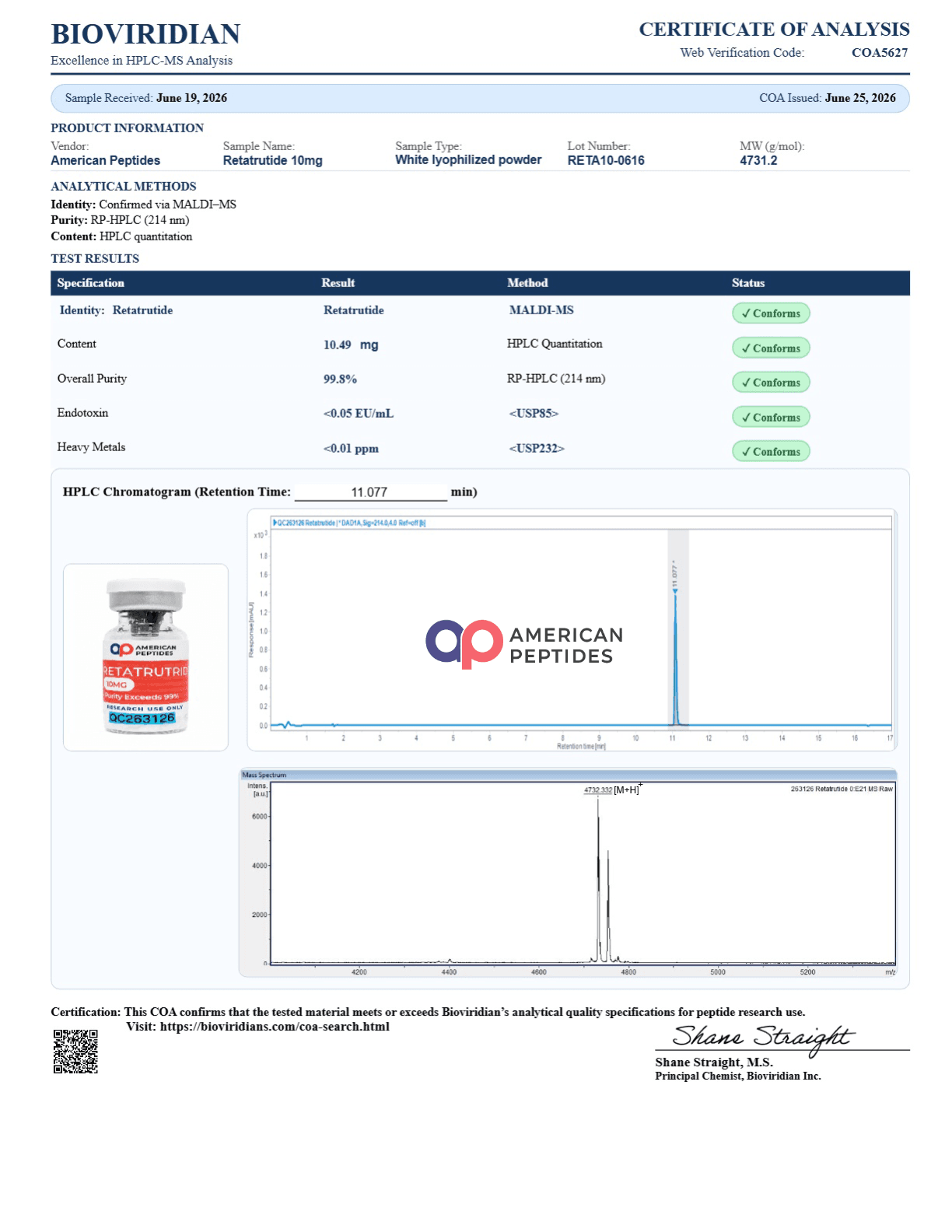
- 1The verification code. A code the lab prints so the report can be checked against the lab's own records, not the vendor's. Everything else is pixels until you confirm the lab issued it.
- 2The lot number. RETA10-0616. This has to match the number printed on your vial. A perfect COA for a different lot tells you nothing about the vial in your hand.
- 3Identity, by mass spec. MALDI-MS confirms the molecule is what the label claims. This is the test that catches an analog sold as the real thing, and the one dishonest vendors leave out.
- 4Content: 10.49 mg. A 10 mg vial that actually holds 10.49 mg, so 4.9 percent OVER label. Legitimate, independently tested, and still not exactly 10. This is why you check assay instead of assuming.
- 5Purity: 99.8 percent. Of the powder present, 99.8 percent is retatrutide. Note this is a different question from the line above it. Purity is what, content is how much.
- 6One dominant peak. This is what a clean chromatogram looks like: a single tall spike at 11.077 minutes and a flat baseline everywhere else. Several large peaks would mean a mixture.
- 7Mass: 4732.332. Compare to the stated molecular weight of 4731.2 at the top. The difference is one proton, because the instrument measures the molecule plus an added hydrogen, written [M+H]+. Expected 4732.207, measured 4732.332, off by 0.125. That is a match.
- 8How to check it yourself. A QR code, a verification URL, and a named chemist who signed it. You can go to the lab's site, enter COA5627, and see whether the original matches the PDF you were sent.
A sixty second walkthrough
Now put it all together on a different report. You've opened a certificate for BPC-157, 10 milligrams.
The sixty second read
Read the header. Compound name, date, and who did the testing.
The compound is what you expect, the date is recent, and an independent laboratory did the work.
Match the lot or batch number against your own vial.
The step almost nobody does, and the one that decides whether the rest of the page applies to your vial.
Confirm identity: the mass spec result, or ID by Spectral on a table format report.
ID by RT shows 1.00 and ID by Spectral lists 999. Combined, those say the vial contains authentic BPC-157. On a graph format report you compare expected mass against measured mass instead.
Read the purity figure off the HPLC section.
This report lists 99.82 percent on one vial and 99.99 percent on the second vial tested, against a floor of 98 percent for research material.
Read the content, sometimes labelled assay, in milligrams.
The assay is 9.22 and 9.30 milligrams on a vial that lists 10 milligrams, so this vial holds around 92 to 93 percent of the peptide stated. Purity would never have told you that.
Verify the document against the lab, not against the vendor.
A verify key, a QR code or a report number entered on the lab's own site returns the original.
A second one, with a problem in it
The retatrutide certificate above is clean. Here is another real report from the same independent lab, this time for BPC-157 at 10 milligrams. Not the table format report from the walkthrough.
Run the sixty second check on it and it passes everything. Purity 99.8 percent. Content 10.02 milligrams on a 10 milligram vial. Endotoxin passed, single clean peak, named chemist, verification code. You would close the tab satisfied. Look for another thirty seconds and two things on the page do not line up.
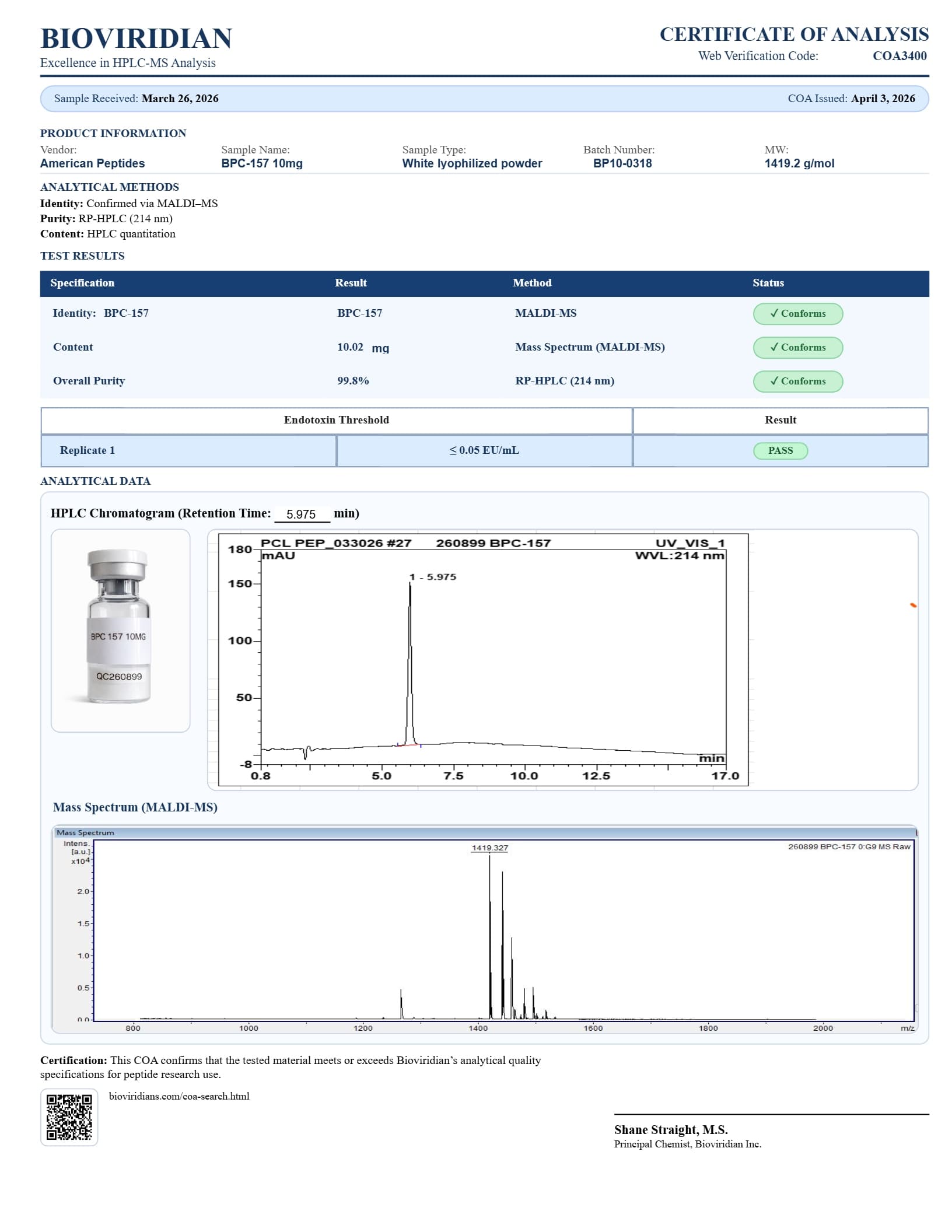
- 1A different code. Same lab as the certificate above, different report, different code. One real report from a lab tells you nothing about whether the next one is real.
- 2What the methods block says. Hold on to this line. It states that content was measured by HPLC quantitation, which is the correct way to do it.
- 3What the results table says. The method for that same content row now reads MALDI-MS, which contradicts the line above. MALDI is an identity test. It weighs molecules. It does not tell you how many milligrams of them are in the vial, and quantities by MALDI need an internal standard. One of these two lines is wrong.
- 4Content: 10.02 mg. The tightest content figure in this article, at 0.2 percent over label. Set it next to the 10.49 on the retatrutide report and the 9.22 in the walkthrough. All three are legitimate independently tested vials and not one of them is exactly 10.
- 5Purity: 99.8 percent. Of the powder present, 99.8 percent is BPC-157. Comfortably above the 98 percent floor, and answering a different question from the row directly above it.
- 6A threshold, not a measurement. This says endotoxin came in at or under 0.05 EU/mL and passed, which tells you it cleared the limit but not by how much. The retatrutide report carried a heavy metals result and this one has no heavy metals row at all. Nothing on a page marks the gap where a test should be.
- 7The number matches the picture. 5.975 minutes stated, and the chromatogram shows one tall peak at 5.975 with a flat baseline either side. Checking the stated retention time against the graph takes two seconds and almost nobody does it.
- 8Two identifiers, one submission. The photographed vial reads QC260899, which is the lab's own sample code and matches the header on both graphs below it. BP10-0318 in the product information is the batch. The batch is what you cross reference against the vial you are shipped.
- 9Mass: 1419.327. Against 1419.2 stated at the top, so a 0.127 gap and an apparent match. Do the check yourself anyway. BPC-157 is a 15 amino acid chain, GEPPPGKPADDAGLV, and adding up its residue masses gives 1419.55. The measurement is fine, since 1419.33 against a true 1419.55 sits within the tolerance this sort of reading carries. It is the reference weight printed on the certificate that is off.
The results are genuinely good, and 10.02 milligrams on a 10 milligram label is the best content number on this page. What the two slips tell you is that the paperwork got less care than the testing.
A certificate that contradicts itself in a small way is a certificate nobody proofread. Someone assembling a fake from a template makes exactly this kind of error. So does a real lab having a busy week. You cannot tell which from the page alone, and that is precisely what the verification code is for.
Who did the testing, and how to check they did
In house means the vendor tested their own product, which is the player grading his own exam. Third party means an outside lab did it, and nobody but the lab benefits from the result.
PDFs are digital images, and anything that's a digital image can be altered. Both certificates here carry a verification code that returns the lab's own original, not the vendor's copy. Without that route back, everything on any PDF is just marketing.
Red flags that should stop you cold
Red flags on a COA
A recycled COA, one old report continually repurposed for other customers
No independent laboratory listed, or no way to verify the document
A cropped or screenshot report with the lab name, date, or peak summary cut off
A suspiciously round number like 100.00 percent purity, or no peak summary at all
A molecular weight that does not match the expected weight for the compound name
A methods section and the results table naming different tests for the same row
Vague dates, or reference-only language tied to no specific batch number
The analog trap
Order research grade Semax and there is a good possibility you will not be getting the original substance. A family of related compounds is sold under closely similar names, including N-Acetyl Semax and N-Acetyl Semax Amidate. An HPLC will not tell them apart, because the weight differences between them disappear into the light impurities on the graph. A mass spectrometer will.
Take N-Acetyl Semax Amidate. The addition of an acetyl group puts its expected weight at 854 Da compared to regular Semax's 813 Da. If you ordered regular Semax and the weight comes back somewhere near 854, the COA has told on the product.
The sixty second checklist
Run this on every COA before you trust it
Does the compound name match what you purchased?
Does the lot or batch number match your vial?
A perfectly good COA for lot 1305 is useless if your vial is lot 1420.
Is the date recent, and relevant to your vial?
Is an independent laboratory listed, one you recognize by name?
Does the report include a method to verify its authenticity?
Are both identity (mass spec) and purity (HPLC) listed?
An HPLC test on a sample that is 99 percent incorrect peptide only tells you that it is 99 percent incorrect.
Is the purity level 98 percent or higher?
Is an assay, or content, listed for the vial?
Purity tells you what you are getting. Content tells you how much. Ask for both.
Are any of the red flags above present?
Nine items, and it only takes one reason for suspicion to find a dishonest vendor.
My take
Reading a COA is about demanding proof rather than accepting claims, and the right kind of proof at that. Know the three questions, know where the answers sit, and know how to check them against the lab rather than the seller.
Nobody is coming to do this for you. The regulatory system that would normally check any of this does not apply here, which is exactly why the document matters and exactly why so many of them are worthless.
Both certificates here came back good and both had something on them worth arguing with. If you have asked a vendor for the certificate covering your own batch, I want to know what came back: the report for your lot, a report for some other lot, or nothing.
Frequently asked
What is a peptide Certificate of Analysis?
A lab report for one specific batch of one specific compound, much like the nutrition facts on a food package but with chemistry instruments doing the measuring. It answers three questions, each from a different test: what the substance is, how pure it is, and how many milligrams are in the vial. Identity comes from mass spectrometry, purity from HPLC, and content, also called assay, from HPLC quantitation.
What is the difference between purity and content on a COA?
Purity is what the material in the vial is made of. Content, also called assay, is how many milligrams of the peptide are in there. Purity is the type of gold, content is how much of it you are getting, and 24 karat is purer than 14 karat but both are alloys. The two numbers can disagree.
What purity percentage should a peptide COA show?
Most sellers offering research peptides should be able to post figures of 98 percent or higher, and the best companies frequently post above 99 percent. Anything lower than 95 percent is dangerous territory. A listed 100.00 percent is worth another long hard look, because chemistry rarely achieves absolute perfection and a suspiciously round number often means the second decimal place was swept under the rug for marketing.
Why does a 10 mg vial rarely contain exactly 10 mg?
A freeze dried vial does not contain only peptide. Residual water and counterions left from manufacturing, commonly acetate and chloride, add to the weight without being peptide. Three legitimate, independently tested 10 mg vials discussed on this page came in at 9.22, 10.02 and 10.49 milligrams.
Can a Certificate of Analysis be faked?
PDFs are digital images and anything that is a digital image can be altered, so the verification route matters more than any single number on the page. Some independent testing facilities print a report code, a QR code and a web address so the report can be checked against the lab's own records. Watch for cropped or screenshot reports, and for two parts of the same document contradicting each other on the same row.
This content is for educational and informational purposes only and is not medical advice. Peptides discussed are research compounds and may not be approved for human use. Nothing here should be used to diagnose, treat, cure, or prevent any disease. Always consult a qualified healthcare professional before starting any peptide, supplement, or protocol. Individual responses vary. Do not self-administer compounds without proper medical supervision.
Get the next one in your inbox
Free. One email a week at most. Unsubscribe in one click.
Double opt-in · No spam · Unsubscribe anytime
Comments
More in Sourcing and safety
- Buying Peptides Without Getting Ripped OffWhen independent labs tested what was actually in the vials, the answer was not slightly weak. In one set, there was no peptide in the vial at all.
- Reconstitution Math, Without the Hand-WavingHow to work out what's actually in the syringe and how to check anyone else's numbers, including mine.